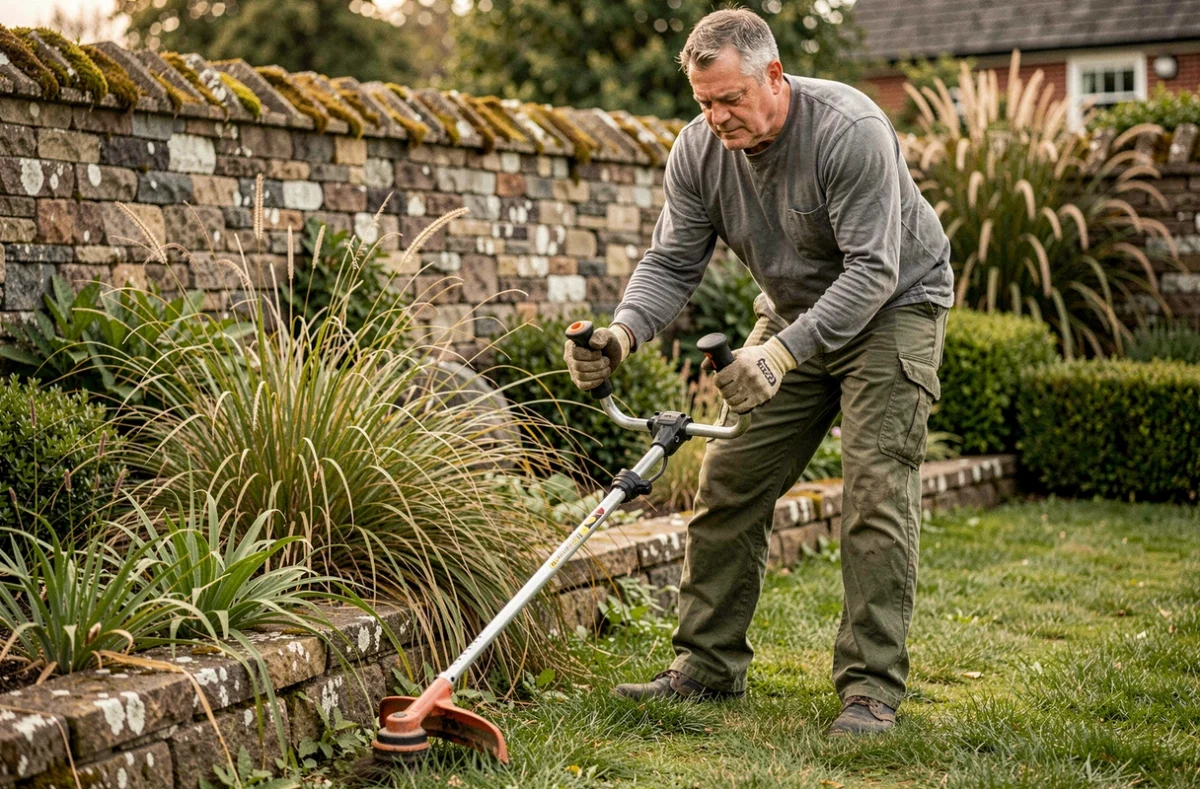
A sloped bank with nettles at the foot of a fence, a flowerbed edge that the mower cannot reach, a dry stone wall surrounded by grasses: it is in these areas that the string trimmer becomes the most sought-after tool in the garden. However, it is essential to choose a model that corresponds to the reality of your terrain and not just to the surface stated on the product sheet.
Rocky terrain or clean edges: the string trimmer does not work the same way
We often think of the string trimmer as a single tool, whereas it covers two very different uses. The first is finishing: cutting the grass along a path, a flowerbed, or a wall, where the mower leaves an uncut strip. The second is light brush clearing: tackling tall grasses, tough weeds, or vegetation on sloped terrain.
This distinction guides everything else. A lightweight battery-powered trimmer is sufficient for lawn edges on flat ground. In contrast, on gravelly or rocky soil, the risk of projection requires a wide protective guard and an appropriate cutting system. The clearance and safety instructions vary from model to model, and the manufacturer’s manual remains the reference to consult before first use.
To find out how to choose a suitable string trimmer for these constraints, it is more efficient to start from the terrain rather than the catalog.
Electric, battery, or gas string trimmer: what the motorization changes on a daily basis
The choice of power source is not just a matter of power. It is primarily a question of range and noise constraints.

Wired electric string trimmer
Light and quiet, it is suitable for small gardens where an outdoor outlet is nearby. The extension cord limits freedom of movement, but you never have to worry about battery life. It is the simplest choice for regular edges on a modest area.
Battery-powered string trimmer
The battery frees you from the constraints of an electric cord. You can access areas far from the house and easily navigate around obstacles. Battery life depends on the battery’s capacity and the density of the vegetation being cut: on short grass, it lasts significantly longer than on tall, wet grasses. One point to check: the battery’s compatibility with other tools from the same brand, which can reduce the overall cost of the equipment.
Gas string trimmer
Reserved for large properties or areas without electrical access, the gas model offers superior power. It is heavier, vibrates more, and generates a noise level that can be problematic in residential areas. Usage times depend on municipal or prefectural regulations, which vary from one municipality to another. Before investing in a gas model, check local noise regulations, especially if the garden is adjacent to close neighbors.
Cutting line, thickness, and section: the detail that changes the quality of work
The cutting line is the main wear part of the string trimmer. Its diameter, section, and feeding system directly influence the result and comfort of use.
- The round line is suitable for soft grass and edge finishing. It wears evenly and produces a clean cut on well-maintained lawns.
- The square or serrated line is better for thick grasses, woody stems, and tough weeds. It is more aggressive and wears differently depending on the density of the vegetation.
- Rotating plastic blades replace the line on some models. They withstand impacts against stone edges better but have a lower cutting capacity on tall grasses compared to a line of appropriate section.
The thickness of the line must match the power of the motor. A line that is too thick on a weak motor slows down rotation and degrades the cut. A line that is too thin on a powerful motor breaks quickly. The string trimmer’s manual always indicates the maximum compatible diameter.
Regarding feeding, there are automatic spool systems (the line comes out when you tap the head on the ground), semi-automatic, or manual. Automatic feeding reduces interruptions during work, a practical advantage on long edges.
Ergonomics and vibrations: the criteria often overlooked before the first back pain
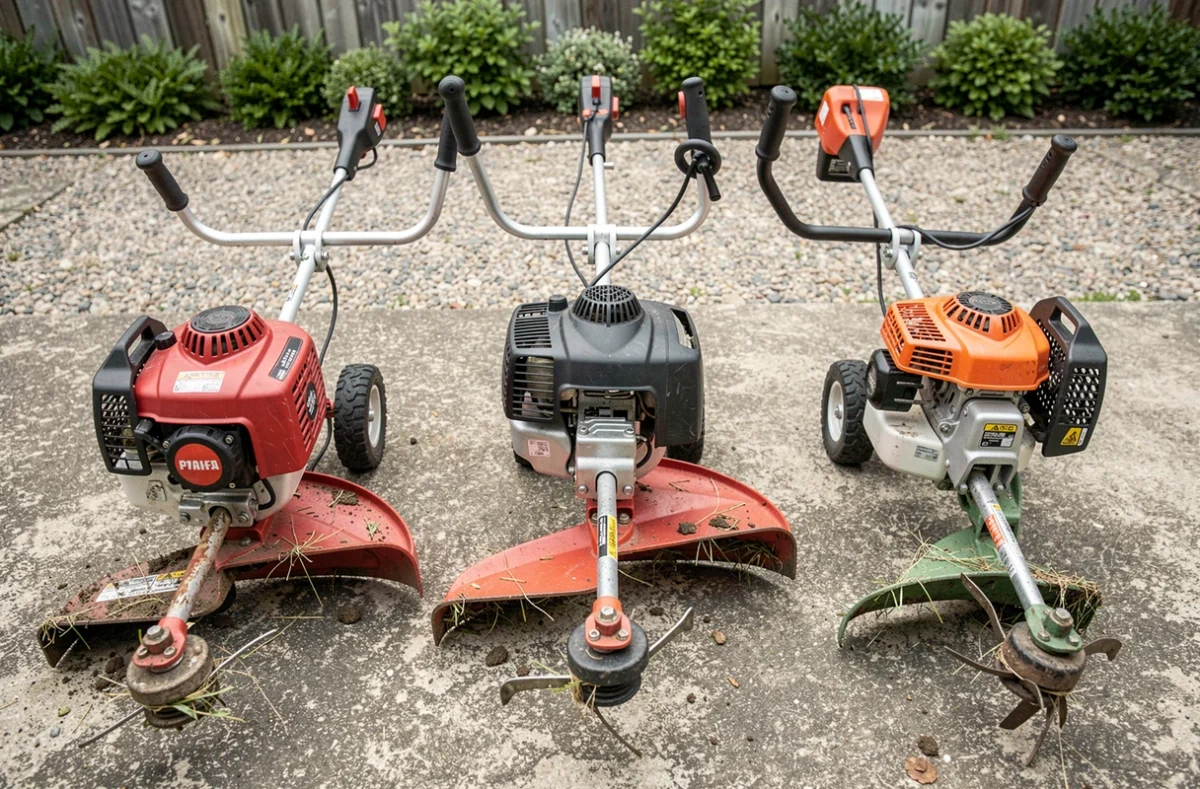
The weight displayed on the packaging tells only part of the story. Two string trimmers of the same weight can be handled very differently depending on the distribution of mass, the length of the handle, and the design of the grips.
For regular use (once a week in season), pay attention to the vibration level indicated by the manufacturer. High vibrations fatigue the arms and shoulders, even during short sessions. A shoulder harness, provided or optional, relieves weight on the forearms and stabilizes the tool during cutting.
The adjustable or tiltable cutting head also makes a real difference. It allows you to work along vertical edges (next to a sidewalk) or under a garden bench without straining your back. Not all models offer this tilt, and the range varies: this is a point to test in-store or check on the technical sheet.
Maintaining the string trimmer: keeping a reliable tool season after season
A well-maintained string trimmer cuts better and lasts longer. The actions are simple but often forgotten.
- Clean the guard and cutting head after each use to avoid the accumulation of wet plant residues that accelerate corrosion.
- Check the condition of the line or blades before each session. A frayed line or a chipped blade destabilizes rotation and unnecessarily strains the motor.
- For a battery model, store the battery in a dry place at moderate temperature, and avoid leaving it discharged for several weeks.
- For a gas model, adhere to the oil change intervals and air filter replacement indicated by the manufacturer.
Choosing a string trimmer comes down to three concrete questions: what terrain, what type of vegetation, what frequency of use. A battery model with round line covers the majority of medium-sized gardens. For sloped, rocky, or densely vegetated areas, you need to increase power and line section while keeping an eye on weight and vibrations. The right string trimmer is the one you take out without hesitation every week.