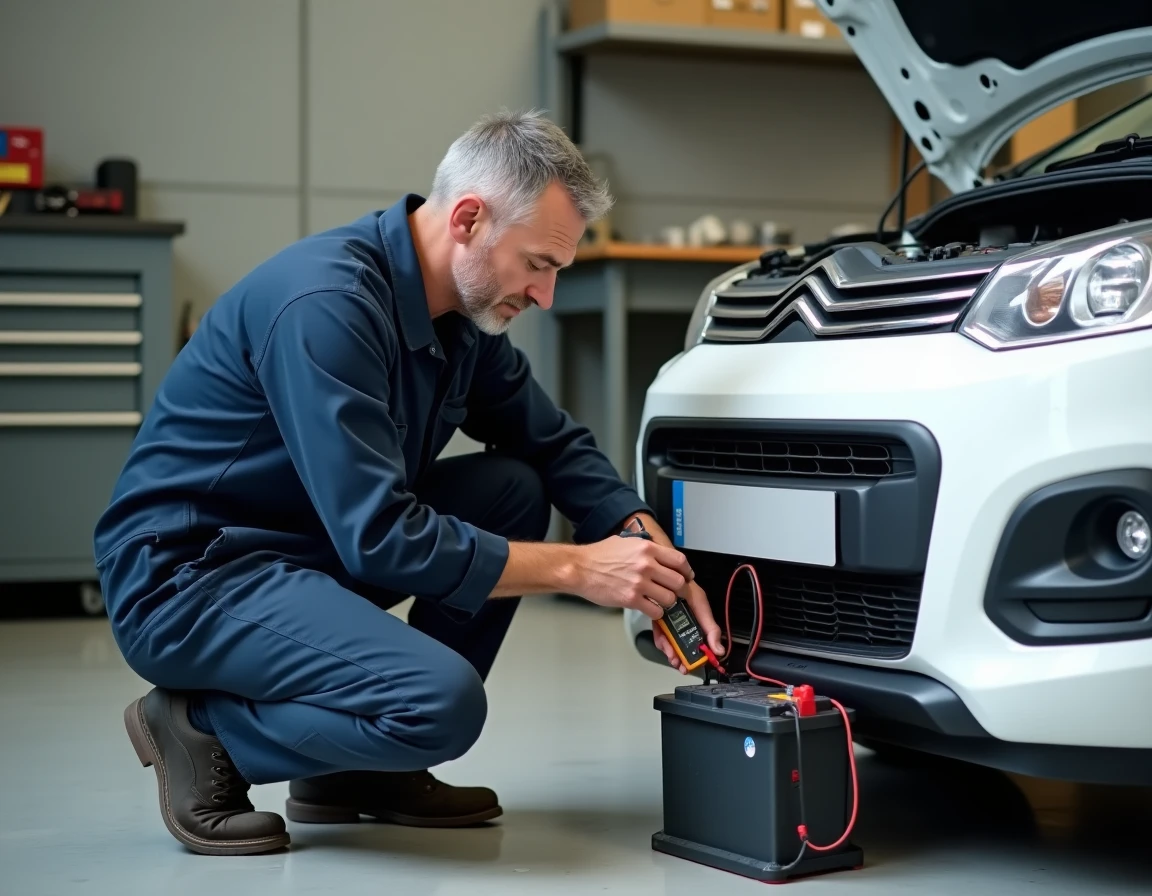
A battery warning light flashing on a Citroën C3, particularly recent versions equipped with Stop & Start, does not always indicate a dying battery. The flashing may point to a charging strategy fault in the ECU, a tired AGM/EFB battery due to short trips, or a deep discharge related to standby consumers.
Understanding the mechanism behind this warning light prevents unnecessary replacement and misdirected diagnostic costs.
ECU Coding After Battery Replacement on Citroën C3
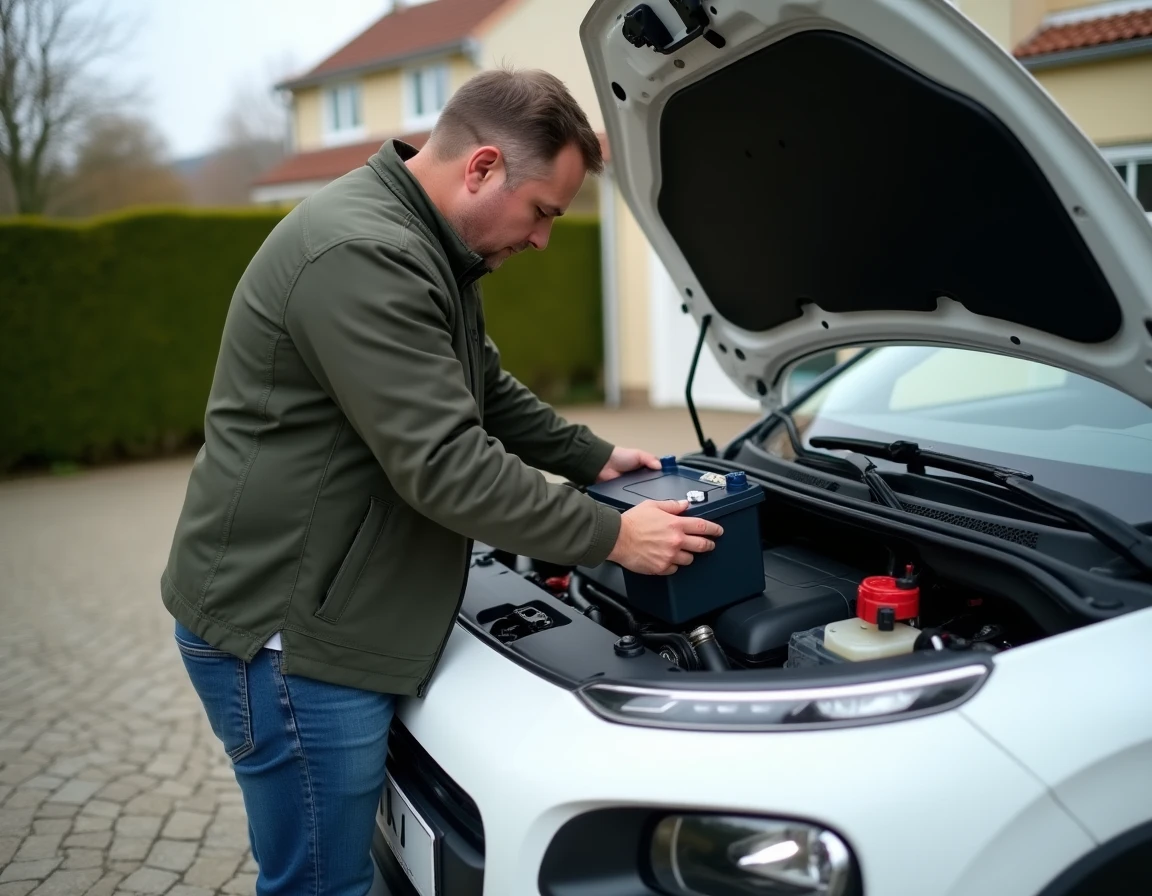
On C3 III models, replacing the battery at a non-specialized auto center frequently causes the battery warning light to flash. The reason is technical: the BSI ECU must receive a declaration of the new battery (type, capacity, AGM or EFB technology). Without this procedure, the charging strategy remains set to the parameters of the old battery.
The result is an inappropriate charging voltage. The ECU may undercharge an AGM battery that requires a higher voltage or overcharge a standard EFB. In both cases, the warning light turns on or flashes to signal an anomaly in the charging circuit, while the alternator operates correctly.
We recommend systematically using a diagnostic tool after any battery change to initialize the ECU. A complete diagnosis of the flashing battery warning light on C3 actually begins with checking this coding, before any other investigation into the alternator or wiring.

AGM, EFB Batteries, and Short Trips: The Real Degradation Factor
Citroën C3 models equipped with the Stop & Start system feature AGM or EFB batteries designed to withstand repeated partial discharge cycles. These batteries tolerate frequent engine stops and restarts at traffic lights or in traffic jams. However, they are very sensitive to a specific usage: repeated short trips without prolonged driving.
On a trip of less than ten minutes, the alternator does not have time to compensate for the energy consumed by starting and electrical equipment. The battery gradually loses real capacity, even if a no-load voltage test shows a correct value.
A simple voltmeter is not enough. It is necessary to measure the actual residual capacity of the battery with a conductance tester. A battery showing 12.4 V at rest may very well have lost half of its starting capacity. This discrepancy between apparent voltage and actual capacity explains why the warning light flashes while the battery seems “still good” under a standard check.
Deep Discharge and Standby Consumers on C3
Since the rise of remote work, assistance networks have reported an increase in breakdowns related to discharged batteries on C3 vehicles that have been stationary for several days. The flashing of the battery warning light upon restart is often a direct consequence of a deep discharge caused by standby consumers.
On a recent C3, several systems remain active even when the vehicle is off:
- The telematics module (network connection, geolocation, remote software updates) continuously consumes measurable standby current
- The volumetric and perimeter alarm keeps its sensors powered continuously
- The keyless entry system regularly emits a signal to detect the key, which drains the battery even without driver interaction
A vehicle left stationary for one to two weeks without driving can reach a critical discharge level. At this stage, a simple jump start does not restore the battery’s capacity. A slow recharge with a smart charger for several hours is essential to recondition the cells and avoid irreversible sulfation.
Smart Charger or Jump Leads
Jump leads allow you to start the engine, but the alternator is not a suitable charger for a deeply discharged battery. Charging via the alternator is too fast and poorly regulated to restore an AGM/EFB battery below 11.5 V. A smart charger applies desulfation, slow charging, and maintenance phases that preserve the battery’s lifespan.
Alternator and Accessory Belt: Diagnose Before Replacing
The common reflex when faced with a flashing battery warning light is to suspect the alternator. This is relevant, but on C3 models, we find that the problem more often comes from the integrated regulator than from the alternator itself.
The voltage regulator, soldered onto the diode bridge in most Valeo alternators mounted on C3, can partially fail. It allows erratic charging voltage: sufficient at stabilized speed, insufficient at idle. The warning light then flashes intermittently, typically in the city at low speed, and then turns off on the highway.
The accessory belt also deserves inspection. A loose or glazed belt slips on the alternator pulley, especially in wet weather. The drop in alternator speed triggers the warning light without any electrical component actually failing. A visual and tactile inspection of the belt (cracks, shiny surface, tension) is part of the basic diagnosis.
- Measure the alternator voltage with the engine running at idle (expected value between 13.8 V and 14.4 V depending on temperature)
- Check the voltage under load (turn on headlights, ventilation, rear window) to detect an abnormal drop
- Inspect the condition and tension of the accessory belt before condemning the alternator
- Check the battery terminals and body ground, a frequent source of false contacts on C3
A structured diagnosis with a diagnostic tool and an oscilloscope on the alternator output distinguishes a faulty regulator from a dead alternator in a few minutes. Replacing just the regulator costs a fraction of the price of a complete alternator, provided the workshop masters the procedure.
The flashing battery warning light on Citroën C3 does not call for a single response. The priority remains to check the ECU coding if the battery has been recently changed, to test the actual capacity rather than just the voltage, and to eliminate simple causes (belt, terminals, ground) before engaging in an expensive replacement. A methodical diagnosis with the right tool avoids most unnecessary replacements.